Top Tech Trends 2026: Innovations Reshaping the Future of Business

Every year, innovations and new technologies disrupt industries at lightning-fast pace; and the tech landscape changes before you can keep up. As the world prepares for 2025, understanding the leading tech trends is essential to remaining competitive.As we further embrace the digital world, 2025 is shaping up as a year with developing technologies taking centre stage. These trends concentrate on what is dictated as beyond what’s ideal in light of the evolving business needs. Anyone in the tech industry will need to understand these major technological advancements, which vary from more intelligent AI to more secure cloud systems. From AI breakthroughs to predictive analytics and cybersecurity, these changes will transform the business landscape. Read on to discover tech trends 2025 and how you can prepare yourself for the future of technology.Let's take a look at the trends that will shape the future of tech.
1. Artificial Intelligence: From Hype to Reality
Artificial intelligence has advanced quickly in the last few years, we can consider it as most promising tech trends 2025. In 2025, it will seep further into our daily work and lives. Artificial Intelligence is now dead on its initial buzz word in the round of technology; it is a driver behind automation, predictive insights, and innovative applications. AI technologies will continue to shape industries from streamlining business processes to enhancing customer experiences. To achieve better efficiencies, personalization, prediction, etc. companies are embracing AI-based tools. Such profound integration will redefine how we live, work, and what we do in service to AI, while opening up new opportunities across sectors and establishing AI as the future-centric companion we need to shape a better future. By 2025, it will be a bigger part of business operations than ever.
What’s on the Horizon for AI:
- Creative AI: We’re seeing an explosion of tools that can create text, imagery and even music. This isn’t merely a novelty; no, this is reconfiguring content production.
- Process Automation: Organizations are relying on AI to take care of repetitive tasks, freeing up employees to work on higher-value activities.
- Data-Driven Insights: By analyzing large datasets, AI can provide insights into customer behavior and predict business outcomes. This can help companies make informed decisions and stay ahead of the competition.
The Cloud Revolution: Beyond Storage
The cloud is fast evolving into the backbone of modern IT. By 2025, its applications will go well beyond simple storage into more innovative domains. The cloud offering essentially provides room for businesses to build solutions which are scalable and agile, rather than just storage space. Cloud-based platforms are enabling real-time collaboration, powering AI-driven analytics and supporting edge computing. Businesses are moving to hybrid models to cater for flexibility and security. In addition to this, serverless architectures will simplify application development. The cloud will become a catalyst for innovation, driving efficiency, improving user experiences, and accelerating digital transformation across industries.
Emerging Cloud Trends:
- Hybrid Cloud Models: More companies are adopting a mix of public and private cloud setups to balance cost, security, and flexibility.
- Edge Computing: Bringing data processing closer to the source will reduce latency and improve performance, particularly for IoT devices.
- Serverless Architecture: Developers can build and deploy applications without managing servers, speeding up the development process.
UX/UI: Crafting Seamless Digital Experiences
In a world dominated by screens; user experience is everything. Customers want apps and websites to appeal quickly, intuitively, and engagingly, and any discomfort on their journey can mean lost business. Get ready for a new wave of applications! Users have evolved to expect a rich experience regardless of which device or platform they are interacting with. They are looking for a personalized experience that speaks directly to them and shows that they are valued. UX/UI design innovation is not only aimed at aesthetics. Companies that prioritize user experience will foster stronger customer loyalty, drive conversions, and stand out in a competitive digital landscape. In 2025, creating flawless digital experiences will be more important than ever.
What’s Evolving in UX/UI:
- Adaptive Interfaces: AI-driven interfaces that adjust to user behavior will become more common.
- Voice and Gesture Commands: Moving beyond touchscreens, users will interact with devices using voice and gestures.
- Accessibility First: Companies are prioritizing inclusive design to ensure everyone can use their digital products with ease.
- Neomorphism 2.0: This design trend will strike a balance between modern aesthetics and functionality, offering users a more natural and immersive digital experience.
Cybersecurity: Guarding Against Evolving Threats
Technology, and hence cyber threats, are increasingly sophisticated and difficult to detect. Fast forward to 2025, and securing digital assets will continue to be important for businesses and individuals. Cybercriminals are using advanced tactics, including artificial intelligence (AI) attacks and the compromising of Internet-of-Things (IoT) devices. With exponentially growing attack surface due to remote work and digital ecosystems, traditional security frameworks are no longer adequate. Organizations will have to implement proactive solutions such as zero trust security architectures and AI-based threat detection. Cybersecurity frameworks will need to be strengthened to protect sensitive data, build trust with customers, and preserve business continuity in a digital-first world.
Key Cybersecurity Trends:
- Zero Trust Security: This approach assumes that threats are already inside your network, requiring verification for every user and device.
- AI-Powered Defense: AI will help identify and respond to threats faster, reducing the risk of data breaches.
- Post-Quantum Encryption: As quantum computing becomes a reality, new encryption methods will be needed to keep data secure.
- Digital Immune System: This concept integrates various cybersecurity tools to create a resilient defense mechanism that automatically detects, responds to, and mitigates threats in real time. Much like the human immune system, it evolves to handle emerging risks and protect critical digital assets.
- Post-Quantum Encryption: As quantum computing becomes a reality, new encryption methods will be needed to keep data secure.
Predictive Analytics: Data-Driven Decision Making
Predictive analytics is revolutionising businesses by converting raw data into insights. By studying past information, businesses can predict future results with striking precision. In 2025, the Rise of Enterprises with this Technology Predictive models will allow organizations to recognize trends, anticipate needs of their customers, and mitigate risks before they develop. Data-driven decision-making that anticipates events this way enables organizations to optimize their operations, and ultimately serve their customers better. Predictive analytics already help industries such as healthcare, finance, and retail with better outcomes. With the market adoption of such technology increasing, those multi-million dollar businesses that jump for it will have an added advantage over competitors.
What’s Driving Predictive Analytics:
- Real-Time Insights: Companies can make faster decisions by analyzing data in real-time.
- Customer Behavior Forecasting: Businesses can predict customer needs and tailor their offerings accordingly.
- Risk Management: Predictive models help identify potential risks, enabling businesses to take proactive measures.
Application Development: Faster, Smarter, More Collaborative
The software development landscape is rapidly changing driven by the need for speed and innovation. In the year 2025, the world of software development will be more agile, collaborative, and accessible than ever before. Low-code and no-code platforms empower more people, including those who may not have the skills traditionally associated with coding, to get involved in the development process. This will be helped by Agile methodologies and DevOps practices that are forming the base for improved team collaboration and shortening feedback loops.
What’s Changing:
- Low-Code/No-Code Platforms: These tools allow users with minimal technical skills to build applications, speeding up innovation.
- API-First Development: Designing applications with APIs in mind ensures seamless integration with other tools and services.
- Progressive Web Apps (PWAs): PWAs offer a native app-like experience on the web, making them a popular choice for businesses.
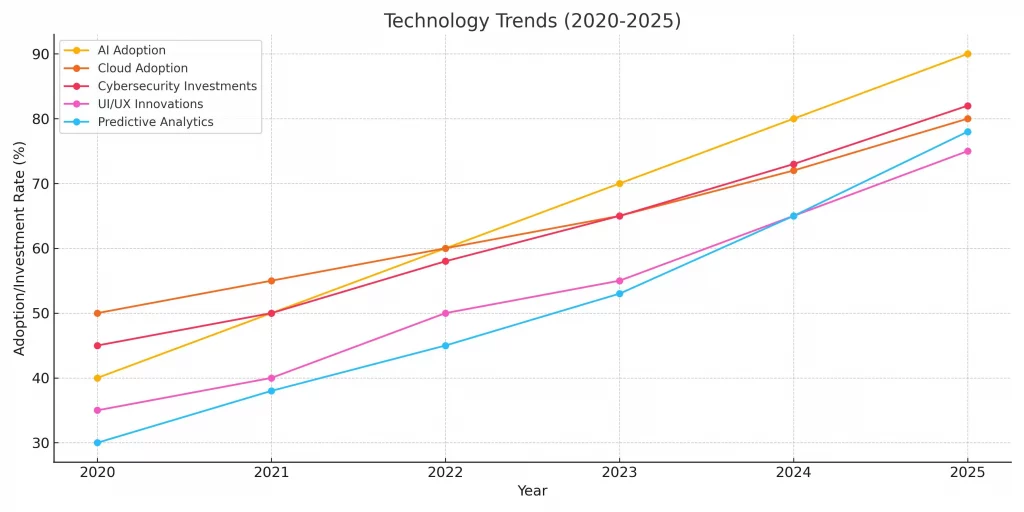
A Connected Future: Where Trends IntersectWhat’s interesting about these trends is their interrelatedness. Cloud capability uplift by AI of services Predictive analytics helps to make better decisions. Cloud solutions improve UX. Strong cyber protection safeguards all of it. Collectively, they form a more versatile and robust tech landscape.Final ThoughtsThe future of tech is exhilarating but also exhausting. Being ahead is accepting these trends and knowing how you can adapt them to your future business. For the tech community, it’s about staying relevant in a fast-moving industry. For companies, it’s about remaining competitive in a digital-first era.Well, are you ready to define the future?
Related Posts

Your Cloud Bill Isn't a Scaling Problem. It's an Architecture Problem.
AI Workflow Automation for Cloud Operations at Scale and Security